A recent phishing email, disguised as a message from a Vassar faculty member, claimed that staff were giving away welding tools. The email appeared friendly and personal, but it was a scam designed to trick recipients into responding to a fake address.
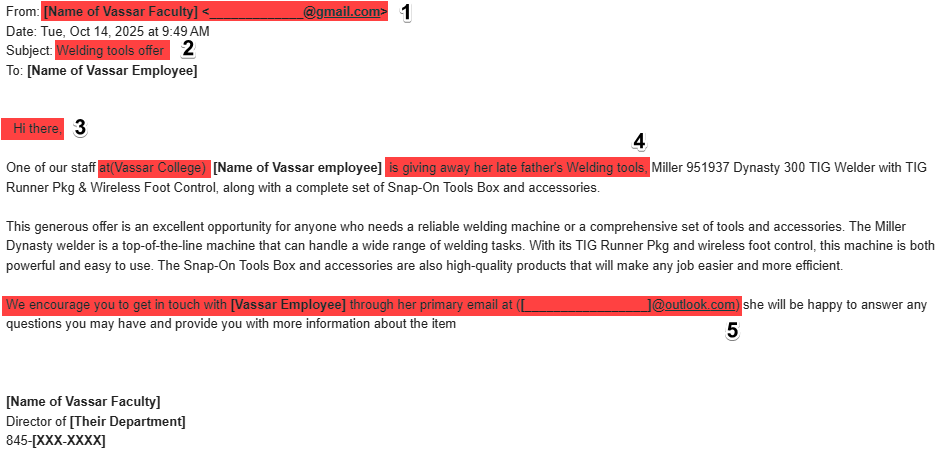
1. The email claims to be from a Vassar faculty member but uses a personal Gmail account instead of an official address @vassar.edu. This is a major red flag, legitimate Vassar communications, especially those from faculty or staff, always come from official institutional accounts. Scammers often use free email services like Gmail or Outlook to impersonate trusted individuals.
2. The subject line, “Welding tools offer,” stands out as unusual for campus communication. Phishers use enticing or curiosity-driven subjects to get recipients to open the message quickly without thinking critically about its legitimacy.
3. The email contains several small but telling mistakes, such as the awkwardly indented “Hi there,” greeting and the missing space in “at(Vassar College)”. Phishing emails often contain odd spacing, inconsistent capitalization, or punctuation errors because scammers quickly copy and paste templates or translate content from other sources. Noticing these subtle mistakes can be an important clue that an email isn’t authentic.
4. The phrase “giving away her late father’s welding tools” is designed to create an emotional connection and lower your guard. Scammers frequently use personal or sentimental stories to make their messages seem more believable. In reality, this kind of personal giveaway is very unlikely to come through official campus channels.
5. One of the major indication of this being a phishing email is the redirection to contact a non-Vassar Outlook address. This is the main goal of the phisher, to direct responses to an external account they control, taking the conversation off the secure Vassar email system. Legitimate staff or faculty member should never use a personal address for college-related communication.