Let’s break down some of the red flags in this phishing attempt a Vassar community member received recently.
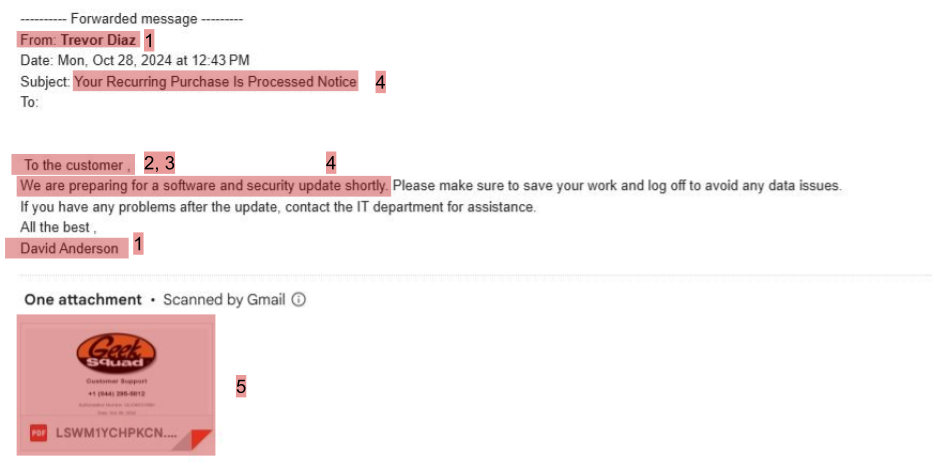
1. Sender not matching signature – Look at who the email client says this email is from, and how they sign the email. They’re two completely different names! This is super common in phishing attempts; you might have experienced this on spam phone calls after. Always check these two names match up!
2. Vague greeting – Phishing attempts will often have vague greetings, such as “customer” or “student,” because they are mass sending them out. A generic greeing like this should always be a red flag.
3. Typos and excess spaces – Phishing attempts often have unusual and incorrect grammar and formatting. In this case, you can see in the greeting (as well as signature) there are extra spaces before and after the words. Whenever an email looks or sounds off, you should be extra suspicious that it’s phishing
4. Difference between subject and content – This email claims that it’s about a recurring purchase being processed, however the body of the email is talking about a software update. This is completely nonsensical, and clearly marks it as a phishing email trying to get your attention through multiple methods.
5. Suspicious attachments – Susipicious attachments are one of the biggest markers of a phishing emails. Notice the name of this attachment; it’s just a string of random numbers and letters. Any attachment with a strange name like this is a pretty good confirmation something is a phishing message. The senders put the Geek Squad logo in this attachment to try to establish some authority, however, much like point 4, there’s really no reason Geek Squad would be involved in this email. Remember, never open or download any attachment from a suspected phishing attempt!
The call to action: This phishing attempt is a great way to learn about reconaissance phishing. At first glance, it may seem that this email has no call to action, aka the action the creator of the phishing attempt wants you to do. However, this email could be reconaissance to identify what email addresses are valid, and what people are likely to fall for phishing. So while this email might not seem as insidious, it can be a way that cyberattackers are trying to get information for a larger or more harmful attack.